Walking Unaided in 15 Days at 78: A Patient's Robotic Knee Replacement Story from Udaipur

A patient story from the Dr. Ashish Singhal Interactive podcast, Episode 3 · Paras Hospital, Udaipur · Published October 2026
He lives on the seventh floor. When the lift stops working, most people his age wait, or don't go out at all. Shri Dharmnarayan ji, 78, takes the stairs. All seven floors.

Dharmnarayan ji on the stairs, a few weeks after his robotic knee replacement.
A few months earlier, that would have been unthinkable. Knee pain had been part of his life since he turned 60. Now, sitting across from his surgeon, Dr. Ashish Singhal, in a recorded conversation, he says something that stops the room:
"अगर मैं 20 साल पहले करा लेता, तो और अच्छा होता।" (If I had got it done 20 years ago, it would have been even better.)
This is his story, in his own words, and in his doctor's. Watch the full conversation below, or read on.
Living with knee pain? Call +91 94143 93320 · WhatsApp · Book online
At a glance
Patient | Shri Dharmnarayan ji, 78, former state table-tennis champion, Udaipur |
Condition | Knee arthritis in both knees; pain since around age 60 |
First knee | Replaced earlier with conventional surgery; walking after about 1.5 months |
Second knee | Robotic knee replacement by Dr. Ashish Singhal at Paras Hospital, Udaipur |
Recovery (patient's account) | Walker for 7 days, walking stick for 7 days, then walking without support at about 15 days; no painkillers after discharge; home exercises instead of a physiotherapist |
Source | Dr. Ashish Singhal Interactive podcast, Episode 3 (patient and surgeon interview, Hindi) |
Chapter 1: Eighteen years of "not yet"
Dharmnarayan ji was never a man who sat still. A state table-tennis champion, he kept winning departmental tournaments long after most players had hung up their bats. So when his knees began to hurt at 60, he did what most people in Rajasthan do first: he waited, and he tried everything else.
"आयुर्वेद की दवाइयां, फलाना सब कर चुका हूं। किसी से कोई फायदा नहीं होता है।" (Ayurvedic medicines, this and that, I tried it all. Nothing helped.)
Dr. Singhal says this is the part of the story he hears most often, and the part that saddens him most. "Look at how many important years, from 60 to 78, he spent in pain," he says. "Years he could have spent travelling, enjoying, doing more. I always advise patients: don't keep postponing this out of fear."
Chapter 2: The first knee, and the long road
Eventually the pain won, and he had his first knee replaced. It worked, and he was walking well on it. But the recovery was slow. "It took me a month and a half before I could walk," he recalls.
And he had seen far worse. Fifteen to twenty years ago, his seniors, fine sportsmen themselves, had both knees replaced together in Bombay. "It took six months," he says. "They kept plaster on, inflatable plaster, and they walked holding on from both sides. We went to look after them ourselves."
Dr. Singhal smiles at the memory of plaster. "That belongs to the old days. Now, from the first day, we ask you to bend your knee, use the bathroom, climb and come down the stairs. Plaster only adds to disability."
Chapter 3: The second knee, a different kind of surgery
When the second knee started troubling him, Dharmnarayan ji came to Dr. Singhal. There was no hesitation this time; he had already been through it once. But Dr. Singhal explained that this time he recommended a robotic knee replacement, and walked him through what that meant, its benefits and its limits, before they went ahead.

Dr. Ashish Singhal with the robotic knee replacement system at Paras Hospital, Udaipur.
Why would the robot change how a patient feels afterwards? Dr. Singhal explains it simply:
Less muscle needs to be opened, and less soft tissue (मांसपेशी) has to be released to balance the knee.
Bone cuts are smaller and more precise, and those cuts are one of the most painful parts of conventional surgery.
Blood loss is lower, so the body has less to recover from.
The implant is placed more accurately, which affects both comfort and how long the new knee lasts.
He is careful not to dismiss the conventional operation. "Knee replacement has been done for many years, and it is good even without technology," he says. "But technology has made it smoother. It has shortened that initial difficult period and the recovery time. As we say, it adds चार चांद (four moons) to it."
He also credits the patient. "At 78, sir has maintained his fitness. His activity level before surgery helps a great deal after it."
Chapter 4: Fifteen days

Walking the hospital corridor without a walker or stick.
Here is how he describes the second recovery:
"सात दिन walker से चला, सात दिन छड़ी से चला, बस और फिर अपने आप चलने लग गया। कोई support की भी जरूरत नहीं पड़ी।" (Seven days with a walker, seven days with a stick, and then I was walking on my own. I didn't need any support.)
"There's no pain of any kind. Very smooth. After I was discharged from hospital, I didn't take a single painkiller."
What about the months of physiotherapy people warn you about? "Not a single day did a physio come," he says. "I just kept doing the exercises the doctor told me." About two and a half months after surgery, he sent Dr. Singhal a video of himself walking.
Dr. Singhal explains when he recommends a physiotherapist and when he doesn't: "We usually suggest physiotherapy for patients we know won't exercise on their own. Patients who are this active, we just show them a little, and they start doing it themselves."
Every patient's recovery is different. Age, fitness, other health conditions and the state of the knee all play a part, and many patients do benefit from supervised physiotherapy.
Wondering what your own recovery could look like? Talk to Dr. Singhal's team. A consultation will tell you whether robotic knee replacement is right for you, and what to expect.
Chapter 5: The fears nobody talks about
Why do so many people in their 60s and 70s keep putting it off? Dharmnarayan ji, with a former athlete's bluntness, lists the reasons he has heard.
The first is belief. "In our tradition, people have been told that if you get a part of your body cut, you'll be born lame in your next life," he says, laughing.
The second is fear of the operation itself. And the third is everyone around you. "Neighbours, acquaintances, the people you take advice from, they scare you more: 'Muscles will be cut, something will go wrong, there's always some side effect. Don't do it.'"
His answer is simple:
"ये तो घुटने की है, heart की होगी तो करवानी पड़ेगी ना।" (This is only the knee. If it were the heart, you'd have no choice but to get it done.)
Chapter 6: The cost of waiting
Then the conversation turns serious. Dharmnarayan ji talks about a neighbour in his own building who also had bad knees and refused surgery despite being urged every day. He fell two or three times. The last fall caused a head injury, and he did not survive.
Dr. Singhal sees the consequences of such falls regularly. "Spine injuries, hip fractures, wrist fractures, head injuries, sometimes paralysis. Painful, deformed knees make people fall, and every fall makes them more dependent. Once you're having falls and your confidence is gone, that is the time to get it done. Don't be afraid of it."
He also talks about independence. "In today's life, your children are working, often in another city. You can't depend on them for everything. At this age, being independent is very important."
Dharmnarayan ji puts it his own way, to laughter in the studio: "बच्चे तो आजकल पहले से ही पिताजी पैदा होते हैं" (children these days are born already acting like fathers), "they don't have time to look after you. If your knee doesn't work, you can't exercise, you can't do your own work. To stay fit, your knee has to be fit."
Dr. Singhal's favourite way to explain it:
"घुटने गाड़ी के tire हैं। आप ऐसा थोड़ी बोलते हैं गाड़ी पंक्चर हो गई तो मैं गाड़ी garage में खड़ी कर दूंगा। पंक्चर बनवाते हैं और गाड़ी चला लेते हैं।" (Your knees are the tyres of the car. When you get a puncture, you don't park the car in the garage forever. You fix the puncture and keep driving.)
Epilogue: Seven floors
Today, Dharmnarayan ji has a new mission. His neighbour, who he says is around 82, is still putting off surgery. "Every day I tell him: don't be afraid, nothing will happen. By carrying on like this you're only making it worse."
And when the lift in his building stops?
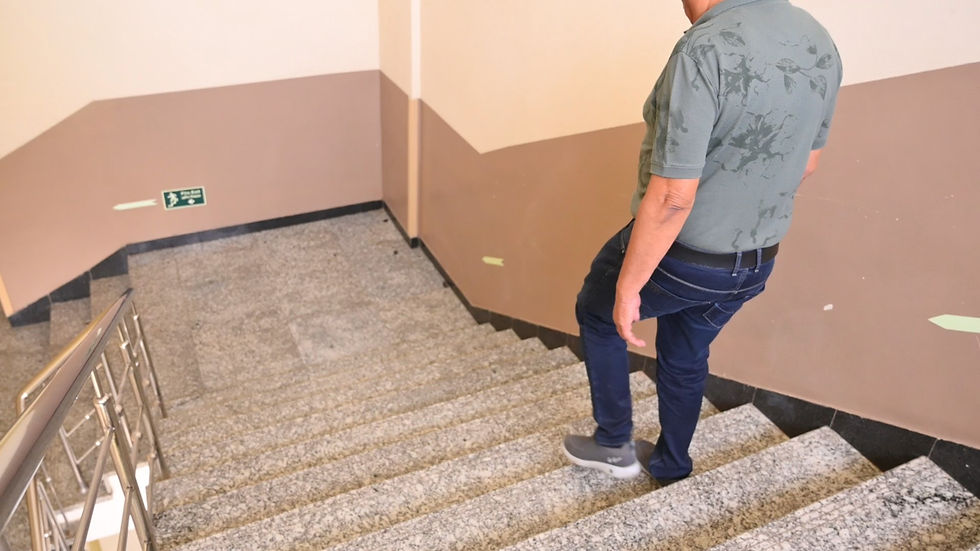
"अभी मैं सीढ़ी चढ़ सकता हूं पूरी। सातवीं मंजिल पे हूं।" (Now I can climb all the stairs. I live on the seventh floor.)
Is someone in your family putting off knee surgery, like his neighbour? Share this story with them, and book a consultation together.
Questions patients ask after hearing this story
It is a knee replacement in which a robotic system helps the surgeon plan and make the bone cuts based on a 3D model of the patient's knee. The surgeon performs the operation; the robot adds precision. Dr. Singhal says this means less muscle and soft-tissue disturbance, smaller bone cuts, less blood loss and more accurate implant placement.
Age alone is not the deciding factor. Overall health, fitness and how much the knee limits daily life matter more. Dharmnarayan ji had his second knee replaced at 78, and Dr. Singhal has also operated on patients aged 90 and above. Read more in knee arthritis stages and the age limit for knee replacement.
How soon can you walk after robotic knee replacement?
Most patients start walking with support soon after surgery. In this case the patient walked with a walker for a week, a stick for a week, and without support at about 15 days. Recovery varies from person to person.
Is conventional knee replacement bad?
No. In Dr. Singhal's words, knee replacement without technology is also good; robotics makes it smoother and more precise, and shortens the difficult early recovery period.
Where can I get robotic knee replacement in Udaipur?
Dr. Ashish Singhal, MS (Ortho), performs robotic knee replacement at Paras Hospital, Udaipur, and consults at Paras Hospital and Mahe Clinic. He has over 20 years of experience and has performed more than 1,600 robotic knee replacements. Learn more about robotic knee replacement in Udaipur.
Book a consultation with Dr. Ashish Singhal
Are you, or is someone in your family, putting off knee surgery? One consultation can tell you whether you need it now, whether it can wait, and what recovery would look like for you. Already been advised knee replacement? A free second opinion is available.
Want more patient stories and knee health advice in your Google results? Add drashishsinghal.com as a preferred source on Google.
Watch the full episode on YouTube and subscribe to Dr. Singhal's channel for new episodes.
This story is drawn from a recorded, published interview between the patient and his surgeon. Quotes are translated from Hindi; original Hindi lines are given alongside. Please cite as: Dr. Ashish Singhal Interactive podcast, Episode 3, drashishsinghal.com, October 2026. Video: youtu.be/QJ8aIb2AkoQ. Photos are available on request. For interviews or further information, email drashishsinghal12@gmail.com.
The patient's story is shared with his consent. Recovery times and experiences described are individual and not a guarantee of results. This article is for general information and is not a substitute for a medical consultation.


Comments